Tutorial 9 of 10
Garden: beds, frost dates, sowing calendar and watering
Beginner 12 min
Plan a vegetable garden in Hearth with beds in 30 cm squares or rows, local frost dates, a sowing calendar, crop rotation, a seed list, a printable plan and watering.
The Garden section plans a vegetable garden from the first seed indoors to the last harvest. You draw your beds, put crops into them for spring, summer and autumn, and Hearth works out the frost dates for your place, when to sow and plant, which seeds to buy, whether a crop family comes back to the same bed too soon, how much sun each bed gets and how much to water this week. Open File → New from template… → Vegetable garden in Berlin to follow along, then choose Garden in the section list (or press B).
Frost dates for your place
Nearly every date in the garden hangs on two frosts: the last one in spring and the first one in autumn.
- In Frost dates and season, keep Frost dates from on Nearest weather station. Hearth uses the coordinates of the place you entered in Good days. If there is none yet, the card sends you there.
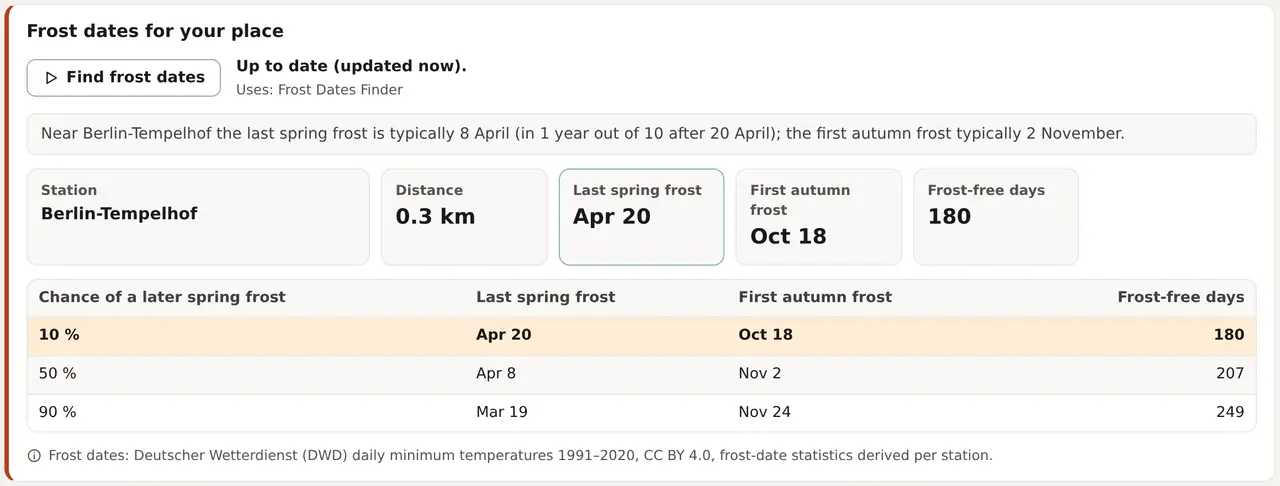
- Choose How cautious to plan. Cautious (10 %) gives the date after which a spring frost came in only one year out of ten — the right choice for tomatoes, courgettes and beans. Typical (50 %) is the middle, Bold (90 %) the early date.
- Pick the Season you are planning. The coming season is this year until July and next year from August on.
Press Find frost dates. For Germany Hearth reads the 1991–2020 records of the nearest Deutscher Wetterdienst station; for the United States NOAA's freeze probabilities. The card shows the station and its distance, your two dates, and a table with all three risk levels.
Elsewhere, switch Frost dates from to My own dates and type your Last spring frost and First autumn frost as month and day, for example 04-20 and 10-15. Your national weather service or an allotment neighbour knows them.
Beds and crops
The card Beds has one button per bed. Add bed creates a new one (up to 12).
- Give the bed a Bed name, its Width (cm) and Length (cm) — measure the inside of a raised bed.
- Choose the Layout: 30 cm squares (square-foot gardening) or Rows.
- Note what grew there in the past: Grown here last year, Two years ago and Three years ago. Hearth uses this for the rotation check.
- Switch between the seasons Early (spring), Main (summer) and Late (autumn). A bed can hold radishes and lettuce in spring, beans in summer and spinach in autumn.
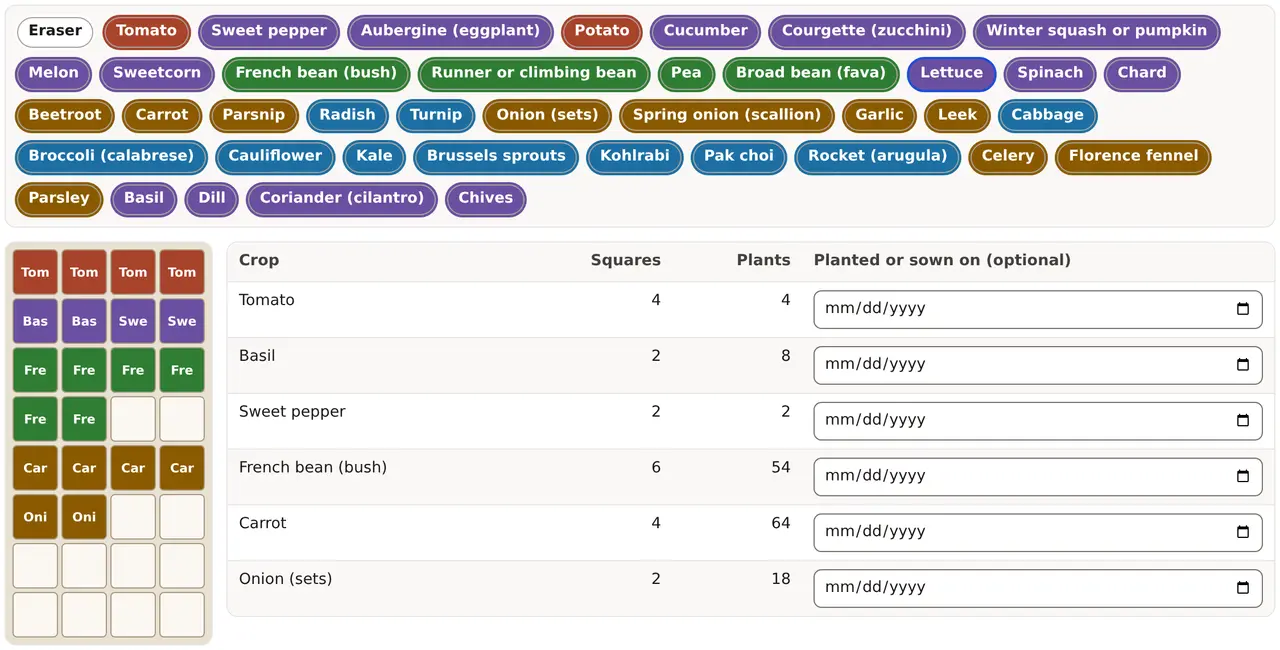
In a square bed, pick a crop in the palette — the colour shows its rotation group — and click a square, or press the mouse and drag over several squares. Clicking a square that already holds the chosen crop clears it; the Eraser clears any crop. With the keyboard, Tab to a square and press Enter or Space. The table next to the bed shows the squares and plants per crop: one tomato per square, four lettuces, nine beans or sixteen carrots. You can add the date a crop went in under Planted or sown on (optional); watering then follows its growth stage.
In a row bed, add one line per crop with the number of Rows. Hearth tells you how much of the bed width the rows need.
Trees, walls or houses that shade a bed go under Trees, walls and houses that shade this bed: the direction from the bed (180 = south), how wide the obstacle looks in degrees, its height and its distance.
Plan check and seed list
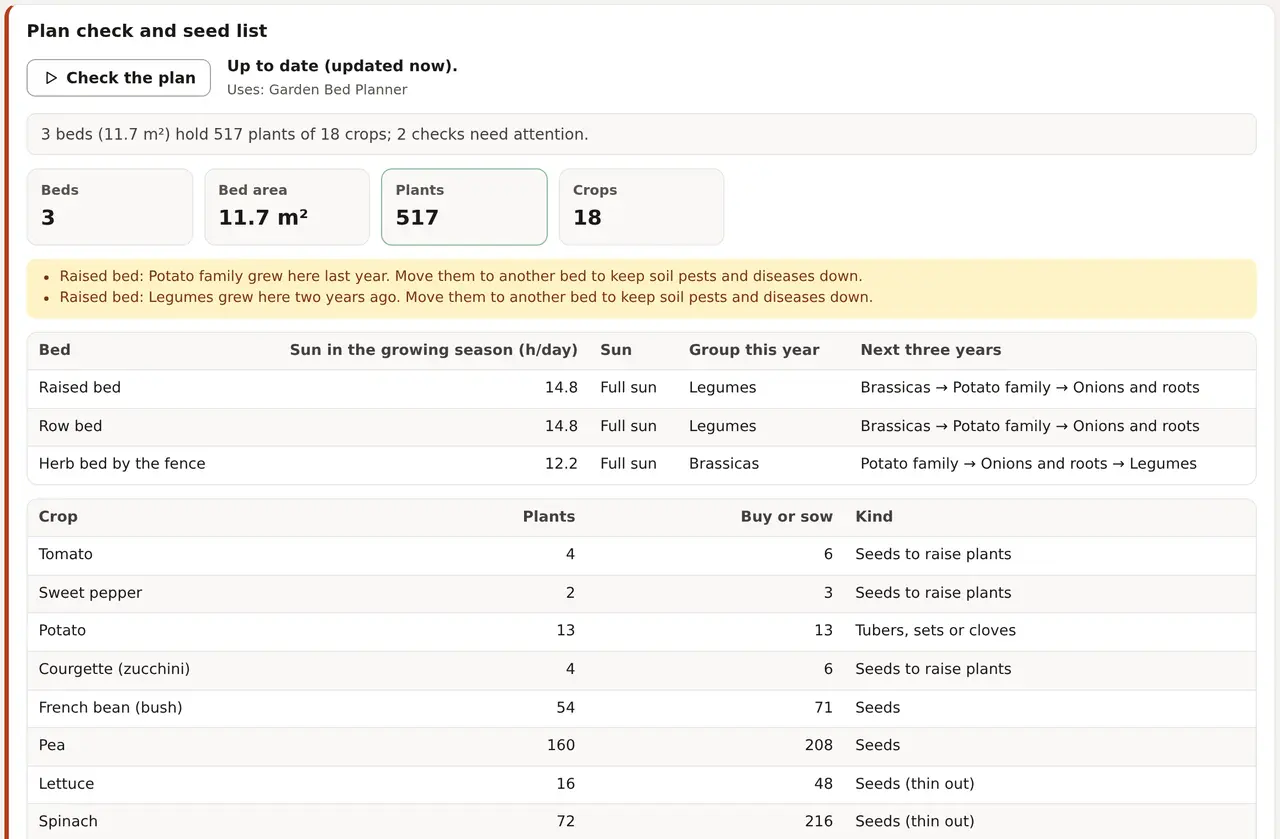
Press Check the plan (or Run all). The card Plan check and seed list shows:
- warnings in yellow, for example Raised bed: Potato family grew here last year. Rotating the four groups — legumes, brassicas, potato family, onions and roots — keeps soil pests and diseases down;
- Sun and rotation per bed: the hours of direct sun per day in the growing season, Full sun or Part sun, this year's group and a suggestion for the next three years;
- the Seed list with the plants per crop and how many seeds, sets or tubers to buy — a little more than the plants, for gaps and thinning;
- Companion planting (tradition, weak evidence): traditional pairs such as tomato with basil, shown for interest.
Print garden plan (PDF) makes a printable plan: every bed and season as a coloured drawing, the seed list, the calendar and the plan checks. Seed list (CSV) opens in a spreadsheet.
Sowing calendar
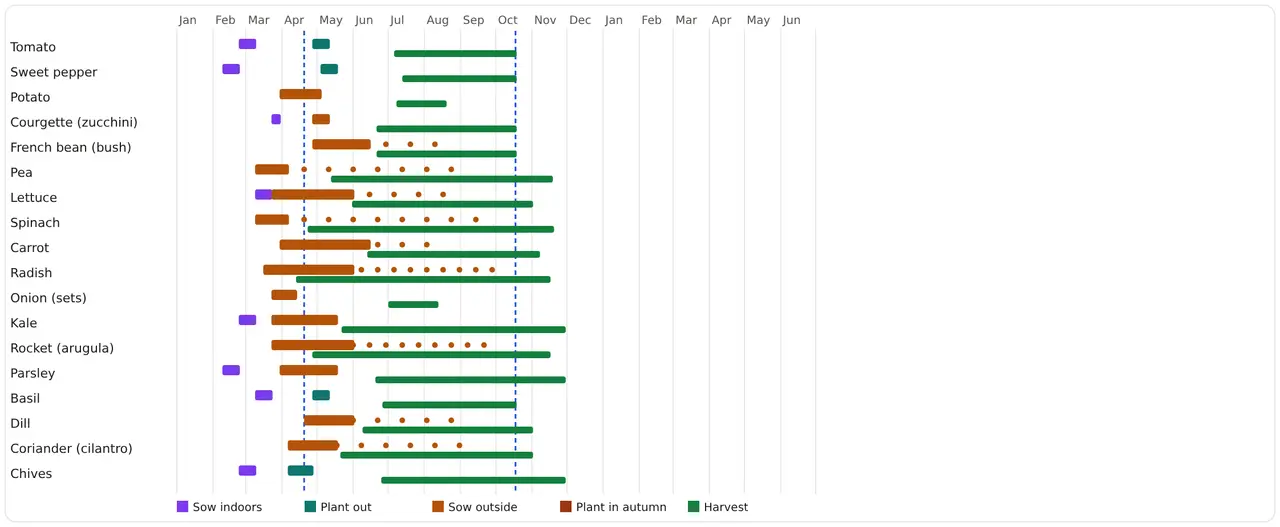
Once the frost dates are known, Make the calendar works out every date for the crops in your beds. The chart shows the whole garden year: purple for sowing indoors, teal for planting out, orange for sowing outside (dots are repeat sowings), green for the harvest. The dashed lines are your two frost dates.
Next dates lists the coming tasks, and All dates per crop the full table. Add garden dates to the calendar (.ics) opens the calendar export with the garden dates selected. The dates also appear in the Dashboard agenda and as findings.
Watering this week
Choose which plantings are in the ground under Plantings in the ground now — usually the season you are in — and press Work out the watering. Hearth reads the MET Norway forecast for your place, works out how much water the crops use (FAO-56 Penman–Monteith with a factor per crop and growth stage), subtracts the rain that reaches the roots and shows litres per bed, how many good soakings that makes and the evaporation per day.
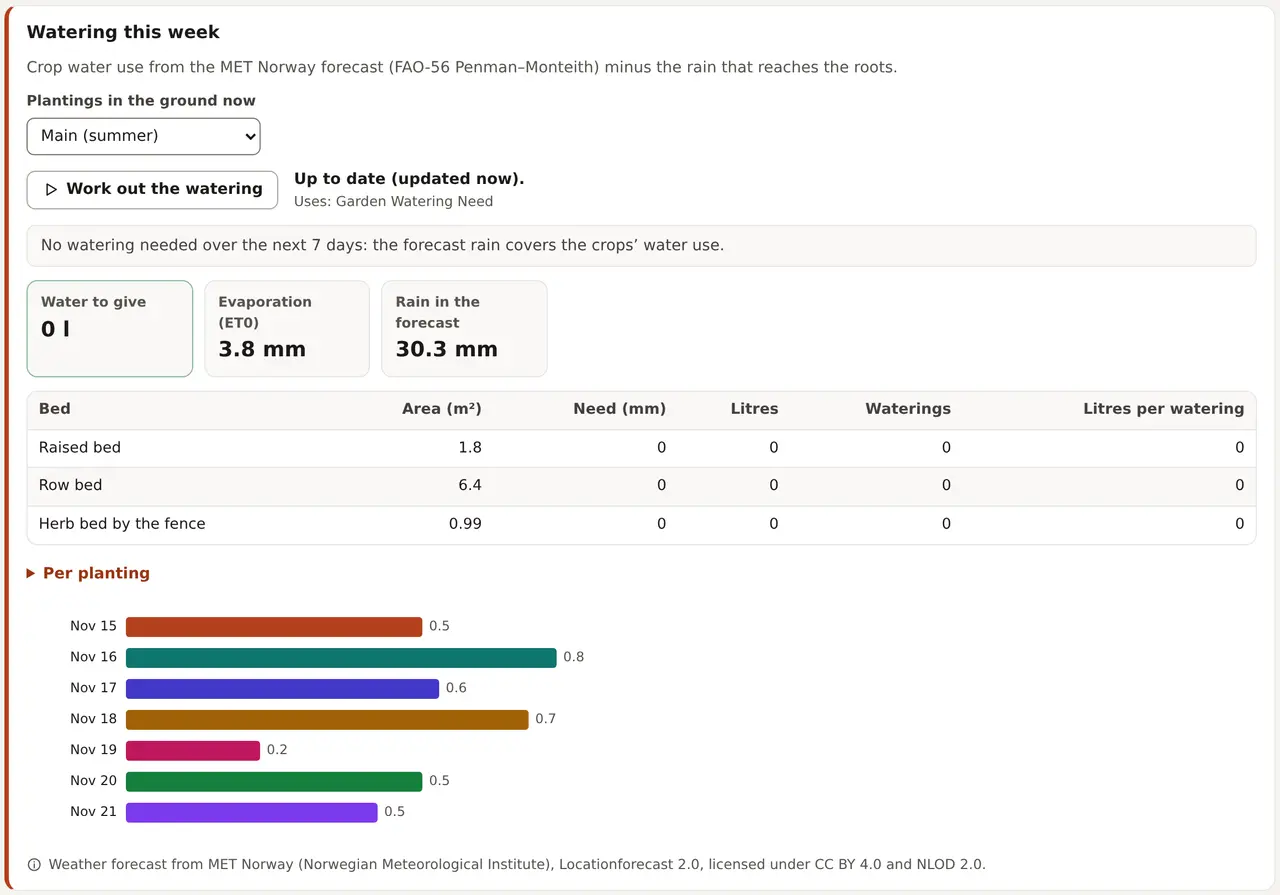
Like the other weather results, the watering ages: the next day it shows as outdated and Run all fetches a new forecast.
Good to know
- The 40 crops have typical timings and spacings from the Royal Horticultural Society's growing guides. Your varieties may be earlier or later; follow the seed packet where it differs.
- Frost here means 0 °C in the air. On clear, calm nights ground frost can come later in spring — cover young plants.
- The four garden tools also run on their own: Frost Dates Finder, Sowing and Planting Calendar, Garden Bed Planner and Garden Watering Need.
Ready to try it?